
Introduction
In tech capitals like Bengaluru, London, and Silicon Valley, SaaS marketing teams frequently fall into the 'traffic trap'—publishing hundreds of generic top-of-funnel blog posts that generate page views but zero qualified demo requests.
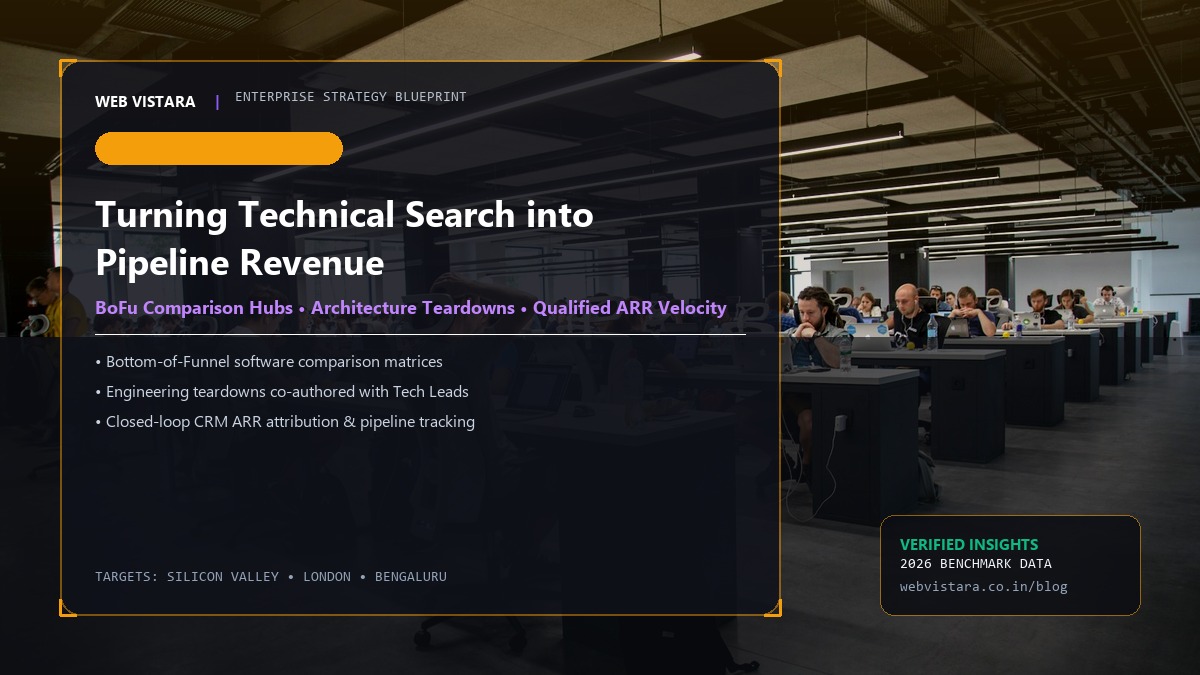
A modern B2B SaaS content strategy prioritizes Bottom-of-the-Funnel (BoFu) and Middle-of-the-Funnel (MoFu) content designed specifically to influence software evaluation committees and generate attributable Annual Recurring Revenue (ARR).
Why This Topic Matters
Enterprise software decisions involve 6 to 10 internal stakeholders, each requiring distinct technical, financial, and operational validation. Broad informational posts fail to convince enterprise architects or CFOs.
Creating specialized product comparison hubs, architecture teardowns, ROI calculators, and migration blueprints directly addresses buyer anxieties and accelerates sales pipeline velocity.
Core Strategic Takeaway
Stop publishing vanity top-of-funnel articles: high-converting SaaS content strategies capture buyers at decision point with transparent comparisons, technical teardowns, and interactive ROI tools.
Core Strategic Pillars
To achieve definitive leadership in this discipline, enterprises must build upon five interconnected technical and strategic pillars:
1. Bottom-of-Funnel (BoFu) First Approach
Prioritizing high-intent comparison matrices ('Competitor A vs Competitor B', 'Best Alternative to X') that capture buyers ready to purchase.
2. Original Engineering Teardowns & Architecture Guides
Publishing authentic technical deep-dives written or co-authored by engineering leads to establish technical credibility.
3. Interactive ROI & TCO (Total Cost of Ownership) Calculators
Building embedded web apps allowing prospective buyers to calculate cost savings and implementation payback periods.
4. Product-Led Storytelling & Embedded Workflows
Demonstrating how your platform solves specific workflow problems using annotated UI screenshots, GIFs, and interactive sandboxes.
5. Multi-Touch Attribution & Pipeline Tracking
Configuring CRM closed-loop attribution to measure revenue generated per blog post rather than arbitrary organic page views.
Step-by-Step Implementation Framework
- Step 1: Sales Call Intelligence & Objection Mining — Review recorded sales demos (Gong, Chorus) to document recurring buyer objections, pricing friction, and rival feature comparisons.
- Step 2: Map BoFu Competitor & Alternative Assets — Map out comparison landing pages and migration guides for every legacy competitor and modern challenger in your market.
- Step 3: Collaborate with Technical Solutions Architects — Author comprehensive integration guides and API implementation blueprints with real code samples to win developer approval.
- Step 4: Embed Interactive Conversion Modules — Embed frictionless ROI calculators, sandbox playgrounds, or self-serve product tours directly within long-form technical content.
- Step 5: Track Closed-Loop ARR Attribution in CRM — Connect HubSpot or Salesforce to attribute pipeline opportunities and closed-won ARR directly to content touchpoints.
Critical Mistakes to Avoid
Execution errors in high-value global markets can severely compromise domain trust and squander investment. Watch out for these crucial pitfalls:
- Outsourcing technical product content to generalist freelance writers who lack software engineering comprehension.
- Publishing gatekeeper-heavy PDF whitepapers that modern technical evaluators refuse to download.
- Avoiding competitor comparison keywords out of unfounded fear of naming rival brands.
- Failing to track revenue attribution and measuring content success solely on superficial organic page views.
Authoritative External Reference Links (Safe for Site Ingestion)
For validated technical specifications, developer guidelines, and regulatory governance, consult these primary industry resources:
- Review official documentation via Gartner: B2B Buying Journey & Buying Group Dynamics.
- Review official documentation via Schema.org: HowTo and Article Schema Guidelines.
The Web Vistara Advantage
Web Vistara engineers high-impact B2B SaaS inbound content engines that turn complex technical value propositions into predictable ARR pipeline for tech leaders across Bengaluru, London, and California.
Our global engineering hub connects performance, search architecture, localized conversion triggers, and continuous real-world analytics to deliver measurable pipeline growth for brands worldwide.
Conclusion
Content marketing for B2B SaaS must be engineered for revenue, not vanity traffic. Focus on bottom-of-the-funnel commercial intent, demonstrate profound technical authority, and watch your sales pipeline flourish.
Looking to dominate search across Bengaluru, UAE, the UK, or North America? Contact Web Vistara today for a specialized technical SEO and GEO roadmap tailored to your enterprise.
Frequently Asked Questions (FAQ)
What is Bottom-of-Funnel (BoFu) SaaS content?
BoFu content targets prospective buyers at the final evaluation stage—such as competitor comparisons, pricing analyses, and customer migration blueprints.
Should B2B SaaS companies write comparison articles against competitors?
Yes. Prospective buyers are already searching for comparisons; if you don't control the narrative on your site, competitors or biased third parties will control it for you.
How do you measure the ROI of a SaaS blog?
Measure pipeline metrics: attributed Marketing Qualified Leads (MQLs), Sales Qualified Opportunities (SQOs), pipeline velocity, and closed-won ARR linked to touchpoints.
Why is Product-Led Content superior to generic thought leadership?
Product-Led content seamlessly weaves your software into the narrative as the natural solution to real-world operational problems, driving higher qualified conversion.
How often should a SaaS blog be updated?
Top commercial BoFu pages, competitor comparisons, and pricing reviews should be updated quarterly to reflect product updates, new feature releases, and evolving market pricing.
Looking to Dominate Global Search & Growth?
Contact Web Vistara today for a specialized technical SEO, GEO, and inbound pipeline roadmap tailored specifically to your enterprise.