
Introduction
Traffic without conversions is an expensive vanity metric. Across digital hubs in Bengaluru, Dubai, London, and California, businesses spend millions acquiring organic and paid visitors only to lose over 97% of them to cluttered layouts, friction-heavy forms, and ambiguous value propositions.
Conversion Rate Optimization (CRO) is the scientific, data-driven discipline of transforming passive visitors into high-paying clients, demo sign-ups, and qualified inbound leads.
Why This Topic Matters
Doubling your conversion rate from 1.5% to 3.0% effectively cuts your Customer Acquisition Cost (CAC) in half and doubles your marketing ROI without spending an additional penny on advertising or link building.
In hyper-competitive global industries, superior CRO unlocks aggressive reinvestment capacity, allowing your enterprise to dominate advertising auctions and outmaneuver rivals systematically.
Core Strategic Takeaway
Conversion rate optimization is the ultimate revenue multiplier: reducing friction on high-intent pages doubles lead volume while halving your blended customer acquisition costs.
Core Strategic Pillars
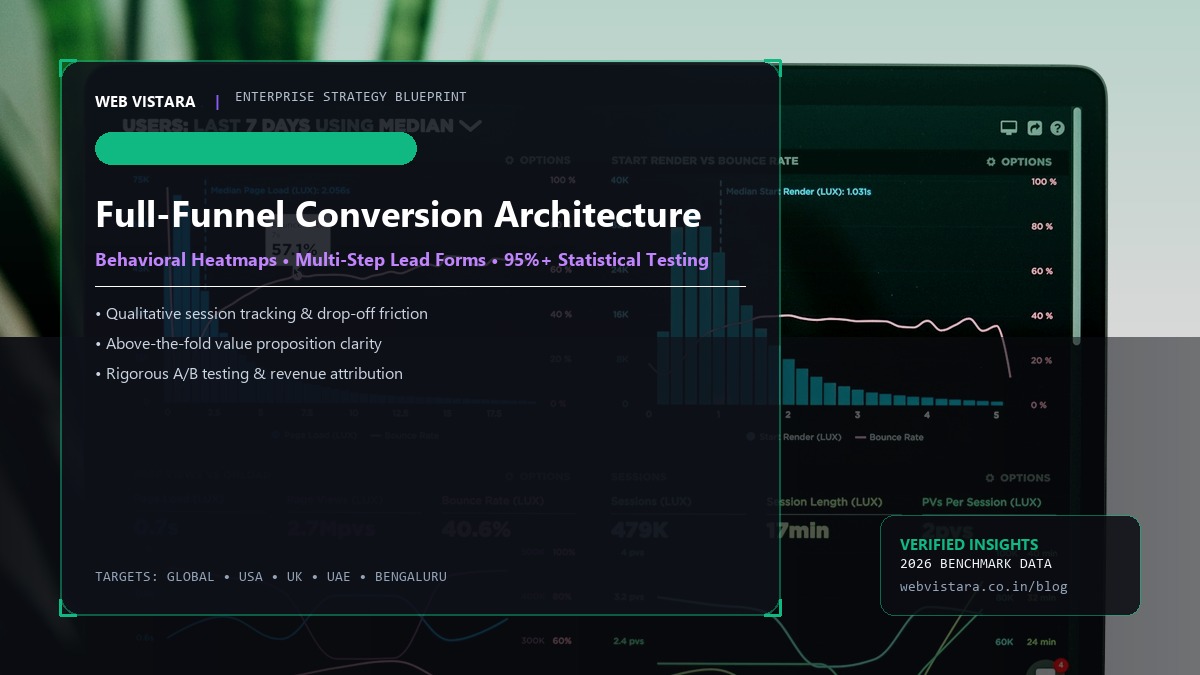
To achieve definitive leadership in this discipline, enterprises must build upon five interconnected technical and strategic pillars:
1. Behavioral Analytics & Qualitative User Tracking
Deploying heatmaps, scroll depth tracking, and session recordings (Hotjar, Microsoft Clarity) to identify drop-off friction.
2. Frictionless Multi-Step Lead Forms
Replacing intimidating 10-field forms with gamified, progressive multi-step forms that maximize completion rates.
3. Above-The-Fold Value Proposition Clarity
Crafting unambiguous headline formulas that explain what you offer, who it's for, and why you are superior within 3 seconds.
4. Psychological Social Proof & Trust Architecture
Strategically embedding verified client logos, third-party video testimonials, and security certifications near CTA zones.
5. Rigorous A/B & Multivariate Testing Protocols
Employing statistical significance calculators to test hypotheses across headlines, copy, colors, and button placements.
Step-by-Step Implementation Framework
- Step 1: Conduct Full Behavioral UX Audit — Analyze GA4 conversion funnels, session recordings, and click heatmaps to identify where high-intent visitors abandon.
- Step 2: Formulate Data-Backed Hypotheses — Develop clear testing hypotheses focused on major friction points (value propositions, pricing clarity, form lengths).
- Step 3: Build Challenger Landing Page Variants — Develop alternative landing page designs in testing environments like VWO or modern client/server-side tools.
- Step 4: Run Randomized Tests to 95% Significance — Ensure sample sizes are sufficient and let tests run across multiple business cycles to achieve true statistical confidence.
- Step 5: Roll Out Winners & Iterate Continuously — Deploy the winning variant into production and launch the next testing cycle to drive compounding conversion gains.
Critical Mistakes to Avoid
Execution errors in high-value global markets can severely compromise domain trust and squander investment. Watch out for these crucial pitfalls:
- Redesigning entire websites based on executive gut feeling rather than verified user behavioral data.
- Testing superficial elements like button colors while ignoring flawed value propositions and confusing copy.
- Declaring A/B test winners prematurely before reaching adequate sample size and statistical confidence.
- Neglecting mobile form usability and touch ergonomics, causing high mobile checkout drop-offs.
Authoritative External Reference Links (Safe for Site Ingestion)
For validated technical specifications, developer guidelines, and regulatory governance, consult these primary industry resources:
- Review official documentation via Nielsen Norman Group: Evidence-Based UX Research & Guidelines.
- Review official documentation via Google Analytics 4: Measuring Conversions and User Journeys.
The Web Vistara Advantage
Web Vistara combines world-class UX design, psychological copywriting, and rigorous statistical A/B testing to engineer high-velocity conversion funnels for enterprises in India, the UAE, the UK, and the USA.
Our global engineering hub connects performance, search architecture, localized conversion triggers, and continuous real-world analytics to deliver measurable pipeline growth for brands worldwide.
Conclusion
Conversion Rate Optimization is the ultimate multiplier of digital growth. Build high-converting, friction-free customer journeys that maximize every click and scale predictable revenue.
Looking to dominate search across Bengaluru, UAE, the UK, or North America? Contact Web Vistara today for a specialized technical SEO and GEO roadmap tailored to your enterprise.
Frequently Asked Questions (FAQ)
What is a good average website conversion rate?
While average conversion rates hover around 2% to 3% across industries, top-performing, CRO-optimized B2B and e-commerce websites frequently achieve 5% to 10%+.
How long should an A/B test run before declaring a winner?
Tests should run for a minimum of two full business cycles (usually 2 to 4 weeks) and reach at least 95% statistical confidence with adequate sample size.
Why do multi-step forms outperform single-step forms?
Multi-step forms leverage the 'foot-in-the-door' psychological phenomenon, starting with low-friction micro-commitments before asking for contact information.
What is the most critical element to test on a landing page?
The primary above-the-fold headline and value proposition. If visitors cannot grasp your core value within three seconds, they bounce before seeing the rest of your page.
Does CRO interfere with SEO performance?
When conducted properly via server-side or clean client-side testing without cloaking, CRO actually enhances SEO by reducing bounce rates and boosting dwell time.
Looking to Dominate Global Search & Growth?
Contact Web Vistara today for a specialized technical SEO, GEO, and inbound pipeline roadmap tailored specifically to your enterprise.