
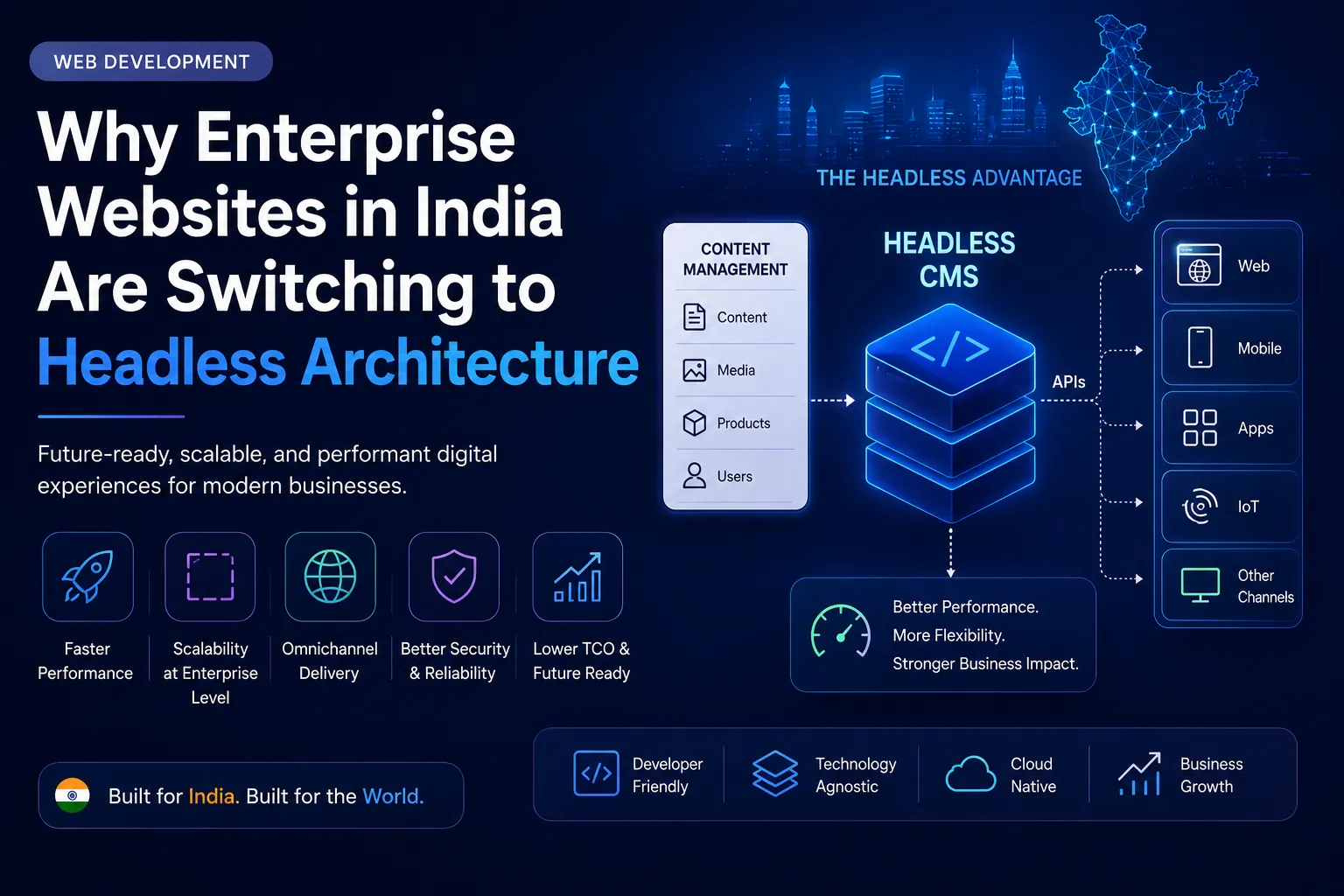
Traditional monolithic platforms like legacy CMS setups are bottlenecking scale for fast-growing Indian enterprises. Decoupling the front-end user experience from the back-end content engine unlocks lightning-fast speed and unshakeable security.
1. What is Headless Web Architecture?
In a headless CMS architecture, the content presentation layer (the "head") is decoupled from the content management repository (the "body"). Content is delivered via high-performance GraphQL or REST APIs to lightweight front-end frameworks like React, Next.js, or Vue.js.
This decoupled stack eliminates server-side database querying on every page request, allowing static edge generation (SSG) and incremental static regeneration (ISR) to serve web pages globally in under 200 milliseconds.
2. Core Advantages for Scaling Brands
- Omnichannel Flexibility: Publish content once and push it simultaneously to web apps, iOS/Android mobile apps, and smart displays via standardized APIs.
- Enterprise Security: Because the database and CMS administration portal are hosted on isolated backend servers behind WAF firewalls, SQL injection and brute-force vulnerabilities are virtually eliminated.
- Sub-Second Page Load: Global CDN edge caching delivers pre-rendered HTML static pages instantly, giving your site top Core Web Vitals scores.
Engineering Recommendation
For Indian enterprises handling over 100,000 monthly visitors, migrating to a Next.js front-end paired with headless CMS infrastructure yields a 90+ Mobile Google PageSpeed score and lowers server hosting costs by 45%.
3. Future-Proofing Enterprise Web Infrastructure
Adopting microservices, API-first, Cloud-native, and Headless (MACH) architecture equips your development team to deploy features continuously without risk of downtime.
Ready to build a headless enterprise web platform?
Consult Web Vistara's full-stack web engineering team in Bangalore.
Explore Custom Web Engineering →