
Introduction
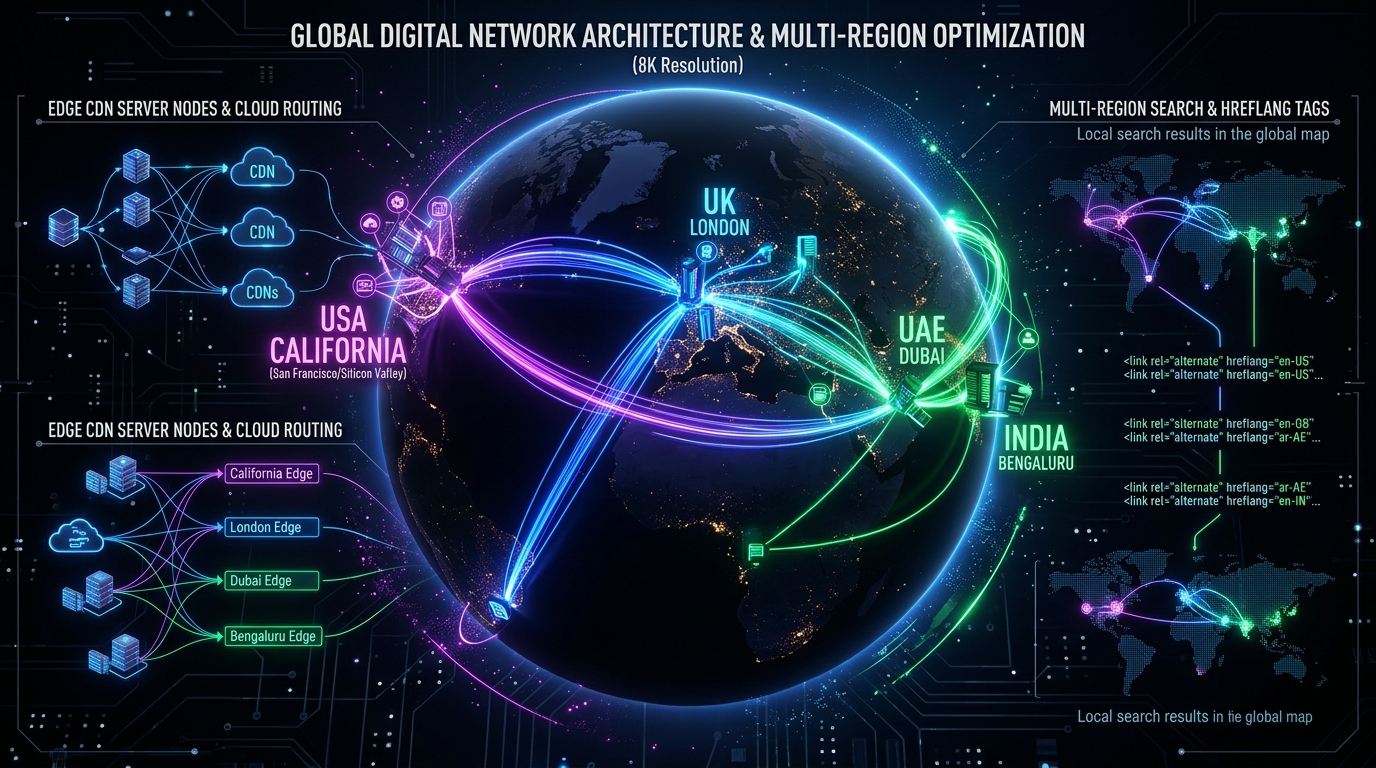
Expanding enterprise operations across international borders requires a rock-solid technical SEO foundation. A company targeting affluent buyers in Dubai, Silicon Valley venture-backed startups in California, enterprise firms in London, and tech innovators in Bengaluru cannot simply duplicate pages across domains.
Geo-targeting errors, currency discrepancies, latency bottlenecks, and improper hreflang tagging can trigger catastrophic indexing conflicts and bleed organic revenue.
Why This Topic Matters
Search engines handle regional relevance with surgical precision. If your UAE portal serves Indian Rupee pricing or your UK landing page links to US spelling conventions without canonical localization, user bounce rates spike and crawl algorithms penalize your domain authority.
International technical SEO establishes immaculate signals that guide search engines to display the exact country-language variant for every user worldwide.
Core Strategic Takeaway
Global search dominance depends on architectural precision: flawless bidirectional hreflang mapping, edge server responsiveness, and culturally authentic regional user experiences.
Core Strategic Pillars
To achieve definitive leadership in this discipline, enterprises must build upon five interconnected technical and strategic pillars:
1. Hreflang Architecture & Canonical Consistency
Implementing bidirectional, error-free hreflang annotations across XML sitemaps or HTML head tags for en-US, en-GB, en-AE, and en-IN.
2. URL Structure Hierarchy
Evaluating ccTLDs, subdomains, and subdirectories (e.g., domain.com/ae/ vs domain.ae) for crawl equity and localization budget.
3. Edge Server Latency & Global CDNs
Deploying Cloudflare Enterprise or AWS CloudFront edge workers to guarantee sub-second server response times in North America, Europe, and Asia.
4. Currency, Tax & Geo-IP Handling
Implementing algorithmic redirection without blocking Googlebot, while respecting regional regulatory standards (GDPR, California CCPA).
5. Local Entity Schema & Geo-Coordinates
Deploying LocalBusiness Schema with regional postal codes, geo-coordinates, and local currency specifications.
Step-by-Step Implementation Framework
- Step 1: Establish Unambiguous URL Taxonomy — Determine whether subdirectories, subdomains, or ccTLDs best align with your enterprise budget and regional brand equity.
- Step 2: Map Bidirectional Hreflang Sitemaps — Map every regional URL pair into an automated dynamic hreflang XML sitemap to eliminate missing return tag errors.
- Step 3: Configure Search Console Target Properties — Set up dedicated regional properties in Google Search Console to monitor local search performance and indexing status.
- Step 4: Audit Multi-CDN Edge Performance — Audit edge routing to eradicate Time to First Byte (TTFB) discrepancies between North America, Europe, the Middle East, and Asia.
- Step 5: Execute Regional Crawler Rendering Tests — Perform headless crawler emulation to ensure dynamic localized content renders cleanly without infinite redirect loops.
Critical Mistakes to Avoid
Execution errors in high-value global markets can severely compromise domain trust and squander investment. Watch out for these crucial pitfalls:
- Automatic IP redirects that trap search engine bots in infinite loops and prevent page crawling.
- Missing self-referencing hreflang tags or omitting bidirectional reciprocation between country pairs.
- Mismatched canonical tags pointing to different language variants instead of the localized version.
- Serving translated content via client-side JavaScript without server-side pre-rendering.
Authoritative External Reference Links (Safe for Site Ingestion)
For validated technical specifications, developer guidelines, and regulatory governance, consult these primary industry resources:
- Review official documentation via Google Search Central: Managing Multi-Regional & Multilingual Sites.
- Review official documentation via IETF Language Subtag Registry (BCP 47 Codes).
The Web Vistara Advantage
Web Vistara engineers robust multi-regional websites and technical SEO frameworks for cross-border tech agencies, e-commerce empires, and consultancy firms operating in Bengaluru, London, Dubai, and California.
Our global engineering hub connects performance, search architecture, localized conversion triggers, and continuous real-world analytics to deliver measurable pipeline growth for brands worldwide.
Conclusion
International technical SEO is the structural bedrock of global scale. By enforcing rigorous hreflang, CDN edge caching, and localized entity markups, your brand captures prime global real estate effortlessly.
Looking to dominate search across Bengaluru, UAE, the UK, or North America? Contact Web Vistara today for a specialized technical SEO and GEO roadmap tailored to your enterprise.
Frequently Asked Questions (FAQ)
What is the best URL structure for international SEO?
Subdirectories (e.g., domain.com/uk/) are generally most cost-effective and consolidate domain authority, whereas ccTLDs (.co.uk, .ae) provide the strongest local trust signals.
Why are hreflang annotations so error-prone?
Hreflang requires strict bidirectional linking: page A must point to page B, and page B must reciprocate to page A. Missing return tags invalidate the entire cluster.
Should I automatically redirect users based on IP address?
Never hard-redirect search engine bots. Instead, display a polite banner suggesting regional switching or redirect only human users while exempting search spiders.
Does hosting location still matter for international ranking?
While CDNs minimize physical distance latency, server responsiveness (TTFB) and Google Search Console regional associations remain paramount ranking signals.
How do I handle multi-currency technical SEO?
Use unique regional URLs for distinct currencies, apply structured Product schema with regional offers, and avoid dynamic client-side currency switching on identical URLs.
Looking to Dominate Global Search & Growth?
Contact Web Vistara today for a specialized technical SEO, GEO, and inbound pipeline roadmap tailored specifically to your enterprise.